

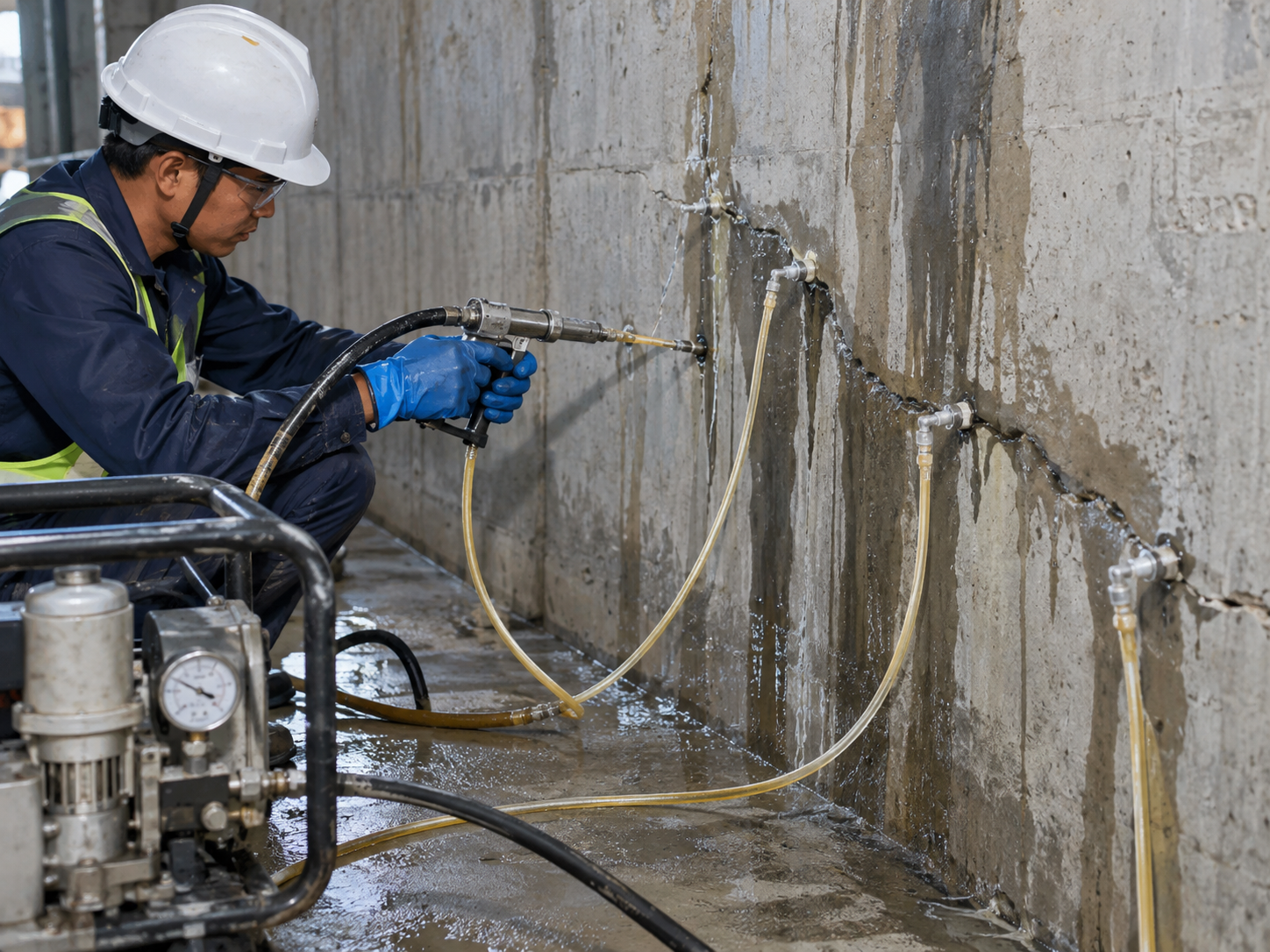
Concrete is widely used for buildings, basements, retaining walls, car parks, water tanks and other structures because of its strength and durability. However, cracks can still develop over time due to structural movement, settlement, shrinkage, construction joints, water pressure or deterioration.
Some concrete cracks are only surface defects, while others can become pathways for water seepage or indicate more serious structural problems.
Crack injection is a concrete repair method that fills cracks and internal voids with specialised materials such as polyurethane (PU) or epoxy resin. The purpose is to stop water leakage, seal the crack and, depending on the material used, restore the integrity of the concrete.
At QingLong Waterproofing Malaysia, crack injection solutions are commonly used for leaking concrete walls, basements, slabs, retaining walls and other areas where water is penetrating through cracks.
What is Crack Injection?
Crack injection is a specialised concrete repair technique where repair material is injected under controlled pressure directly into a crack.
Unlike simply applying waterproofing material over the visible surface, injection allows the repair material to penetrate deeper into the crack or void inside the concrete.
Once injected, the material reacts or cures within the affected area, sealing the pathway that allows water to enter.
The two materials most commonly associated with concrete crack injection are polyurethane injection resin and epoxy injection resin. Each serves a different purpose and should be selected according to the condition of the crack.
PU injection is commonly used where water leakage is present, while epoxy injection is generally selected when bonding and structural repair are required.
Why is Crack Injection Used?
Concrete cracks should not automatically be treated in the same way.
Before carrying out repair work, it is important to understand whether the problem is caused by water pressure, shrinkage, structural movement, construction defects or deterioration of the surrounding concrete.
For water seepage problems, simply coating the surface may not always solve the source of leakage. Water can continue travelling through the crack or internal void behind the coating.
Crack injection addresses the water pathway directly.
By filling the crack internally, the repair can help stop water penetration without requiring extensive removal or replacement of the surrounding concrete.
This makes injection particularly useful for locations where accessing the opposite side of the concrete is difficult.
How Does Crack Injection Work?
A professional crack injection repair normally begins with an inspection of the affected concrete.
The contractor identifies the crack location, width, moisture condition and possible source of water penetration. The surrounding concrete should also be checked to determine whether there are hollow areas, movement or other defects that may affect the repair.
The crack area is then prepared and injection points or packers are installed at suitable intervals.
Repair material is pumped through these injection points under controlled pressure. The resin travels through the crack and surrounding voids until the affected area is sufficiently filled.
For leaking cracks, polyurethane resin can react with moisture and expand within the crack, helping block the water pathway.
After injection is completed and the material has cured, the injection points are removed or finished and the surface can be repaired as required.
Proper injection requires control of pressure, material quantity and injection sequence. Excessive pressure may damage weak concrete, while insufficient injection may leave internal voids untreated.
PU Injection for Water Leakage
Polyurethane injection, commonly called PU injection, is one of the most widely used methods for repairing water-leaking concrete cracks.
PU resin is particularly useful where water is actively seeping through concrete.
When suitable polyurethane injection material comes into contact with moisture, it reacts and expands inside cracks and voids. This allows the material to fill irregular spaces that may be difficult to seal using conventional surface-applied waterproofing.
PU injection can be applied to areas such as basement walls, concrete slabs, retaining walls, lift pits, underground structures, construction joints and other concrete elements affected by water seepage.
It is important to remember that PU injection primarily focuses on stopping water leakage and sealing water pathways. If the crack is structural, further assessment and another repair method may also be required.
Epoxy Injection for Structural Concrete Cracks
Epoxy injection serves a different purpose.
While PU injection is commonly associated with water leakage treatment, epoxy injection is generally used for repairing stable structural cracks where strong bonding between the separated concrete sections is required.
Low-viscosity epoxy can penetrate narrow cracks before curing into a hard material that bonds the concrete together.
The crack must be properly assessed before epoxy injection is selected. Cracks that are actively moving may require another solution because rigid epoxy may not accommodate continued movement.
Structural cracks should also be assessed by an appropriately qualified engineer where necessary. Injection repair should not be used to hide a structural problem without first identifying its cause.
What Types of Concrete Cracks Can Be Repaired?
Crack injection can be applied to many concrete defects, but suitability depends on the crack condition.
Foundation and basement wall cracks are common applications, especially when groundwater or external moisture pressure causes water to enter through the concrete.
Concrete slab cracks can also become leakage points, particularly around roofs, podium slabs, car parks and other exposed concrete areas.
Retaining walls may experience leakage through cracks or construction joints due to water accumulating behind the structure.
Injection can also be considered around lift pits, tunnels, water-retaining structures and other difficult-to-access concrete areas.
However, cracks caused by continuous structural movement should not simply be injected without further investigation.
The first objective should always be to determine why the crack developed.
Crack Injection vs Surface Waterproofing
Crack injection and waterproofing coatings solve different parts of a water leakage problem.
Surface waterproofing creates a protective layer over the substrate to prevent water from entering the concrete.
Injection works inside an existing crack or void to block an established leakage pathway.
For example, if an existing concrete roof has several cracks, injection may first be carried out on deeper leaking cracks. The surface can then be repaired and an appropriate QingLong waterproofing system applied over the roof for broader waterproofing protection.
Using the correct combination of crack repair and waterproofing helps address both the immediate leakage point and the surrounding area.
Why Professional Crack Injection Matters
Successful injection repair is not simply a matter of pumping resin into a hole.
Incorrect injection positions, unsuitable material selection or excessive pressure may leave parts of the crack untreated or create new problems.
Before beginning work, the contractor should determine the direction of the crack, possible water pathway and condition of the surrounding concrete.
The repair material must also match the purpose of the work.
For example, a leaking crack may require a water-reactive polyurethane injection system, while a dry and stable structural crack may be more suitable for epoxy injection.
Professional assessment therefore plays an important role in achieving a reliable repair.
QingLong Waterproofing Malaysia Crack Injection Solutions
QingLong Waterproofing Malaysia provides waterproofing and concrete leakage repair solutions for residential, commercial and industrial projects.
For concrete structures affected by cracks or water seepage, the appropriate repair method can be selected according to the actual site condition.
Instead of treating only the visible water stain, the objective is to identify the leakage pathway and determine whether injection, waterproofing coating, joint treatment or a combination of repair methods is required.
Crack injection can be particularly useful for basements, concrete roofs, retaining walls, lift pits, car parks, concrete slabs, underground structures and other difficult leakage locations.
Need Concrete Crack or Water Leakage Repair in Malaysia?
Visible cracks, water stains or active seepage should be inspected before the damage spreads to surrounding areas.
QingLong Waterproofing Malaysia provides professional waterproofing and concrete leakage repair solutions based on actual site conditions. Whether the problem involves a leaking concrete crack, basement seepage, roof slab leakage or retaining wall, the correct repair system should address the source of the problem rather than simply covering the visible symptoms.
Contact QingLong Waterproofing Malaysia to arrange an inspection and find a suitable crack injection or waterproofing solution for your project.
Frequently Asked Questions (FAQs)
1. What is PU injection waterproofing?
PU injection waterproofing involves injecting polyurethane resin into cracks, joints or voids in concrete. The resin reacts with moisture and fills the leakage pathway, helping stop water seepage through the concrete.
2. Can PU injection repair all concrete cracks?
No. PU injection is mainly used for leakage control. Structural cracks or continuously moving cracks may require further assessment and a different repair method.
3. What is the difference between PU injection and epoxy injection?
PU injection is commonly used to stop water leakage because polyurethane can react with moisture and fill cracks or voids. Epoxy injection is normally used for stable structural cracks where strong bonding between concrete sections is required.
4. Can crack injection stop basement leakage?
Yes, crack injection is frequently used to repair water seepage through cracks in basement walls, retaining walls and underground concrete structures. The effectiveness of the repair depends on correctly identifying the actual leakage pathway.
5. Is waterproofing still needed after crack injection?
It depends on the condition of the area. Injection treats individual cracks or leakage pathways, while a waterproofing system protects a wider surface. Some projects benefit from using both methods together.


