

When protecting basements, foundations, retaining walls and other below-ground structures, choosing between waterproofing and damp proofing is an important part of the system design.
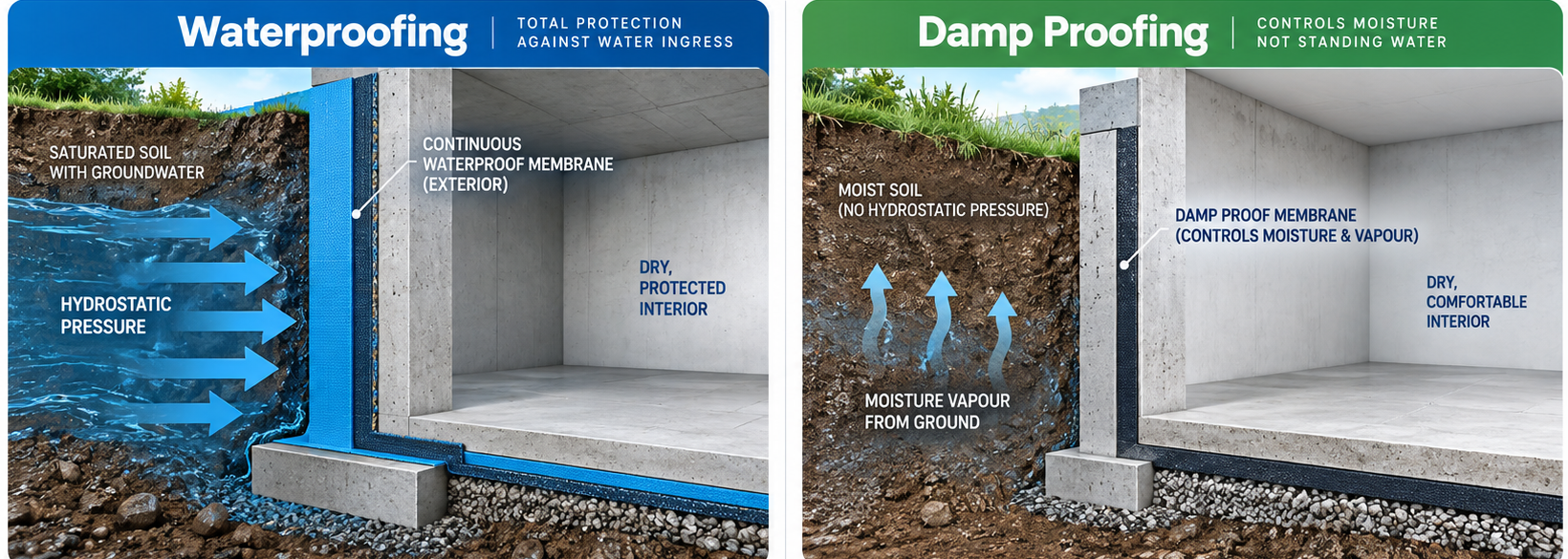
Although both methods help protect a building from moisture, they serve different purposes. Damp proofing is mainly designed to reduce moisture and water vapour passing through a structure, while waterproofing provides a stronger barrier against actual water ingress.
At QingLong Waterproofing Malaysia, we provide waterproofing solutions for residential, commercial and industrial projects, including below-ground areas where moisture, groundwater and hydrostatic pressure can become long-term concerns.
Understanding the difference between waterproofing and damp proofing helps contractors, consultants and property owners select a system that matches actual site conditions.
What Is Waterproofing?
Waterproofing is designed to prevent water from penetrating into a building structure.
Unlike basic damp-proof protection, a properly designed waterproofing system can protect concrete foundations, basements and retaining walls where groundwater or hydrostatic pressure may be present.
Below-ground structures are particularly vulnerable because water can remain in continuous contact with concrete. Once cracks, construction joints or weak areas develop, water may find a path into the structure.
QingLong waterproofing systems create a continuous protective layer around vulnerable areas to reduce the risk of water penetration.
Depending on the project requirements, waterproofing systems may include waterproof membranes, bituminous membranes, cementitious waterproofing materials, liquid-applied coatings and joint treatment systems.
Key Benefits of Waterproofing
1. Protection Against Water Ingress
The main purpose of waterproofing is to create a barrier that prevents water from entering the structure. This is especially important for basements, underground structures, lift pits, retaining walls, foundations and other areas exposed to groundwater.
2. Suitable for Hydrostatic Pressure
When groundwater builds up around a below-ground structure, it creates hydrostatic pressure against the walls and floor slab. In these conditions, damp proofing alone may not provide sufficient protection. A properly specified waterproofing system is normally required to withstand prolonged water exposure and pressure.
3. Protection for Concrete Structures
Water entering reinforced concrete can eventually reach the steel reinforcement. Continuous moisture exposure may contribute to reinforcement corrosion, concrete deterioration and cracking. Preventing water penetration therefore helps extend the service life of the structure.
4. Multiple Waterproofing Systems Available
Different projects require different solutions. QingLong Waterproofing Malaysia provides waterproofing systems suitable for various substrates and construction methods, allowing contractors and consultants to select a solution according to the structure, application area and expected water exposure.
What Is Damp Proofing?
Damp proofing is primarily designed to control moisture rather than resist significant water pressure.
A Damp Proof Membrane (DPM) creates a moisture-resistant layer that helps prevent ground moisture and water vapour from moving upward through floors, walls or concrete slabs.
Damp proofing is commonly used where the structure may experience ground moisture but is not expected to face continuous groundwater or significant hydrostatic pressure.
For example, a damp proof membrane may be installed beneath a ground floor slab to help prevent moisture from migrating upward into the internal floor system.
Key Benefits of Damp Proofing
1. Helps Control Rising Moisture
Ground moisture can migrate through porous construction materials through capillary action. A damp proof membrane helps interrupt this movement and reduces moisture entering the occupied areas of the building.
2. Suitable for Non-Hydrostatic Conditions
Damp proofing works well where moisture is present but significant water pressure is not expected. This makes it suitable for many slab-on-ground applications and other relatively low-risk areas.
3. Protects Internal Finishes
Excessive moisture moving through floors and walls may contribute to peeling paint, damaged flooring, mould growth, staining and deterioration of internal finishes. Installing an appropriate damp proof system can reduce these moisture-related problems.
4. Can Be Integrated with Other Waterproofing Systems
Damp proof membranes can also form part of a broader building protection system. Different waterproofing and moisture-control materials may be used together depending on the foundation design, groundwater conditions and construction requirements.
Waterproofing vs Damp Proofing: What Is the Main Difference?
The biggest difference is the level of water protection each system is designed to provide.
Damp proofing primarily controls moisture and water vapour. It is generally intended for situations where there is little or no hydrostatic water pressure.
Waterproofing provides a more complete barrier against water penetration and is suitable for areas where direct water exposure or groundwater pressure may occur.
For example, a ground floor slab located above relatively dry soil conditions may only require an appropriate damp proof membrane.
However, a basement wall surrounded by groundwater requires a much stronger waterproofing system because water can continuously press against the structure.
When Should You Use Waterproofing?
Waterproofing should be considered when the structure has a significant risk of direct water exposure.
Typical applications include basements, underground car parks, lift pits, retaining walls, foundations, tunnels, water tanks and other below-ground concrete structures.
The waterproofing system should also pay close attention to vulnerable areas such as construction joints, pipe penetrations, corners and cracks.
Even a high-performance waterproof membrane can become ineffective if these details are not properly treated.
When Should You Use Damp Proofing?
Damp proofing is suitable where the main concern is moisture migration rather than water pressure.
Common applications include ground floor slabs, certain foundation walls and other areas where moisture may rise from the soil but groundwater is unlikely to exert continuous pressure against the structure.
Before choosing a DPM, the site conditions should be assessed carefully. If there is a possibility of groundwater accumulation, drainage problems or hydrostatic pressure, a full waterproofing system may provide more reliable protection.
Why Site Conditions Matter
There is no single waterproofing system that is suitable for every below-ground project.
Soil conditions, groundwater level, drainage design, concrete condition, construction method and building use can all affect the type of protection required.
For example, a shallow residential floor slab and a multi-storey basement may both be located below ground level, but their waterproofing requirements can be completely different.
The basement may experience substantially greater groundwater pressure and therefore require a more comprehensive membrane and joint waterproofing system.
Proper assessment before installation helps reduce the risk of selecting an unsuitable material.
Choose the Right QingLong Waterproofing Solution
Choosing between waterproofing and damp proofing should be based on the actual conditions of the project rather than simply selecting the most convenient material.
If the area is exposed mainly to ground moisture or water vapour without significant water pressure, a suitable damp proof membrane may provide sufficient protection.
If groundwater, continuous water exposure or hydrostatic pressure is expected, a complete waterproofing system should be considered.
With more than 30 years of waterproofing industry experience, QingLong provides waterproofing solutions for residential, commercial, industrial and infrastructure projects.
Our team can assist contractors, consultants and property owners in identifying suitable waterproofing materials for foundations, basements, retaining walls, concrete slabs and other below-ground applications.
For professional waterproofing solutions in Malaysia, contact QingLong Waterproofing Malaysia for product recommendations and technical support.


