

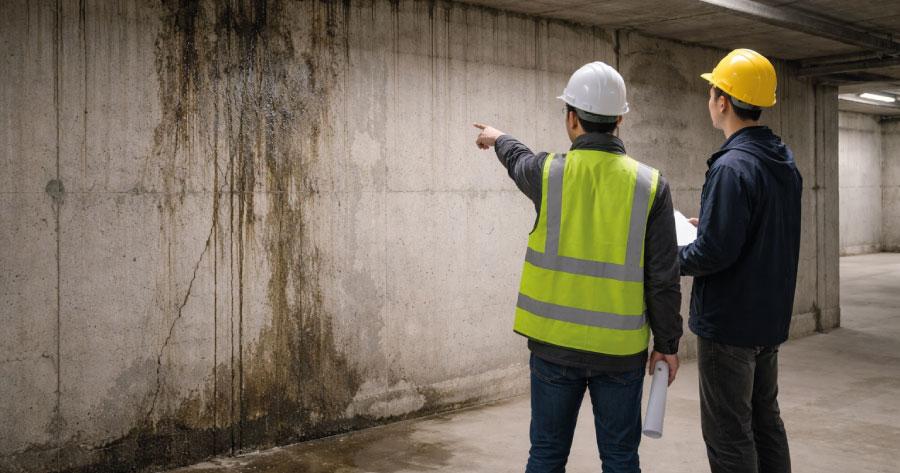
Underground waterproofing maintenance is essential for protecting basements, underground car parks, retaining walls, lift pits and foundation structures from groundwater infiltration. Unlike exposed roof waterproofing systems, underground waterproofing membranes are often concealed beneath concrete, soil or protective layers, making defects difficult to identify and repair once leakage occurs.
In Malaysia, underground structures may be exposed to prolonged rainfall, high soil moisture and changing groundwater conditions. Without proper waterproofing protection and maintenance, water can penetrate concrete cracks, construction joints, pipe penetrations and damaged membrane systems, potentially affecting the durability and usability of the building.
QingLong Waterproofing provides waterproofing materials, technical consultation and solutions for residential, commercial and industrial applications in Malaysia. With over 30 years of industry experience, we help property owners, contractors and project teams understand waterproofing requirements and identify suitable solutions for different site conditions.
Whether you are maintaining an existing basement waterproofing system or addressing water seepage in an underground car park, understanding the causes of water ingress is the first step towards effective waterproofing maintenance.
What Is Underground Waterproofing Maintenance?
Underground waterproofing maintenance refers to the inspection, monitoring and repair of waterproofing systems installed below ground level to prevent water penetration into building structures.
These systems are designed to protect concrete structures against soil moisture, groundwater pressure and water infiltration through vulnerable construction details.
Common underground waterproofing applications include:
Basement waterproofing: Protecting basement walls and floor slabs against groundwater penetration.
Underground car park waterproofing: Preventing water seepage through concrete slabs, walls and construction joints.
Retaining wall waterproofing: Protecting below-ground retaining structures from moisture and groundwater infiltration.
Lift pit waterproofing: Managing water ingress into lift pits to protect equipment and surrounding structures.
Foundation waterproofing: Protecting building foundations and below-ground concrete structures.
Underground utility rooms: Reducing moisture-related problems in electrical rooms, storage areas and service spaces.
Regular inspection and timely maintenance help identify developing defects before they cause more extensive damage.
Why Is Underground Waterproofing Maintenance Important?
Underground structures face different waterproofing challenges compared with exposed building surfaces.
Groundwater can exert pressure against basement walls and foundation slabs, while construction joints and concrete penetrations may become potential leakage pathways.
If existing waterproofing systems deteriorate or drainage arrangements become ineffective, water may gradually enter the building.
Common consequences include:
1. Persistent Water Seepage
Water may penetrate basement walls, floor slabs and construction joints, resulting in damp patches, water stains or active leakage.
2. Concrete Deterioration
Continuous moisture exposure, particularly when combined with aggressive environmental conditions, may contribute to concrete deterioration and reinforcement corrosion.
3. Efflorescence and Wall Finishing Damage
Water moving through concrete can transport dissolved salts towards the surface, leaving white crystalline deposits known as efflorescence. Persistent moisture may also cause paint deterioration and peeling finishes.
4. Increased Maintenance Costs
Unresolved underground leakage may require more extensive investigation and repair, particularly when waterproofing membranes are concealed behind concrete or backfilled soil.
5. Disruption to Building Operations
Water accumulation in underground car parks, storage areas and service rooms can affect building operations, maintenance activities and the usability of the space.
Proper underground waterproofing maintenance helps property managers detect these issues early and plan suitable corrective measures.
5 Essential Underground Waterproofing Maintenance Practices
Maintaining an underground waterproofing system involves more than applying another waterproofing coating. The condition of the concrete, drainage arrangements, construction joints and existing membrane system must also be considered.
1. Inspect Basement Walls and Floor Slabs
Basement retaining walls and concrete floor slabs should be inspected regularly for signs of water penetration and deterioration.
Look for:
- Damp patches or visible water stains.
- Cracks along concrete walls and floor slabs.
- Efflorescence on concrete surfaces.
- Water seepage around wall-to-floor junctions.
- Moisture surrounding pipe penetrations and construction joints.
Pay particular attention to areas where different concrete sections meet, as these locations may become vulnerable to leakage if joint detailing or waterstops are defective.
Recommended maintenance: Document the location and condition of defects. Monitor whether moisture increases after prolonged rainfall or appears continuously, as this information can help specialists investigate possible water entry routes.
2. Maintain Underground Drainage and Sump Pump Systems
Drainage systems play an important role in managing water accumulation around underground structures.
Depending on the waterproofing design, underground facilities may use perimeter drains, drainage channels, collection pits and sump pumps to manage groundwater or accumulated water.
Blocked drainage channels or malfunctioning pumps may cause water to accumulate and increase the demand on the waterproofing system.
Recommended maintenance includes:
- Removing sediment and debris from accessible drainage channels.
- Checking inspection chambers for blockages.
- Testing sump pumps according to manufacturer recommendations.
- Inspecting pump alarms and backup arrangements.
- Checking discharge pipes for obstruction or leakage.
Important: Drainage systems should be maintained according to the original waterproofing design. They should not be treated as a replacement for defective waterproofing membranes.
3. Inspect Construction Joints and Concrete Connections
Construction joints are common locations for water penetration in underground concrete structures.
These joints are formed where separate concrete pours meet, such as basement walls connecting to floor slabs or adjoining sections of retaining walls.
Water may enter when joint seals deteriorate, waterstops become defective or concrete develops cracks around the joint.
Depending on the leakage condition, appropriate repair methods may include:
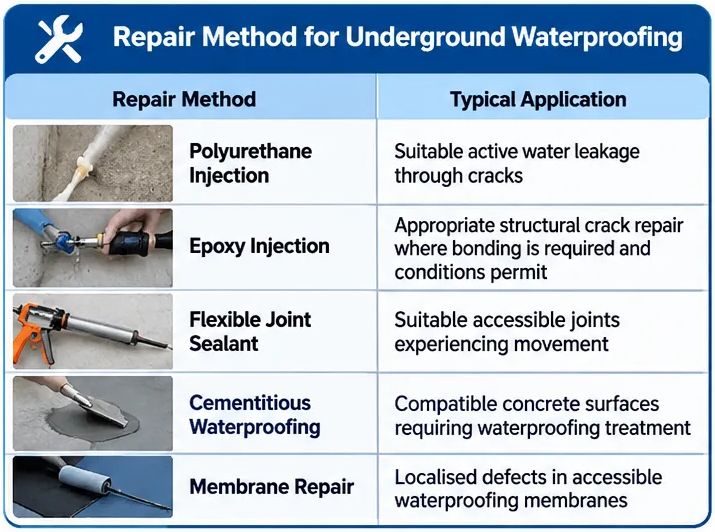
- Polyurethane injection: Used for suitable active water leakage through cracks and joints.
- Joint sealing: Applying compatible joint sealants to appropriate accessible joint details.
- Waterproofing reinstatement: Restoring defective waterproofing details where access is available.
- Waterstop repair: Addressing defective waterstop arrangements where technically feasible.
Maintenance recommendation: Identify the leakage pathway before selecting a repair method. Applying surface waterproofing material over a leaking construction joint may not resolve water penetration originating from within the concrete.
4. Monitor Concrete Cracks and Active Water Seepage
Concrete cracks can provide pathways for groundwater to enter underground spaces. However, different cracks require different repair approaches.
Before carrying out repairs, specialists should assess:
Crack width and depth.
Whether the crack is stable or actively moving.
Whether water is actively flowing through the crack.
Whether the crack is associated with structural movement.
Whether groundwater pressure is affecting the affected area.
Depending on the condition, possible repair methods include:
5. Protect Existing Underground Waterproofing Membranes
Underground waterproofing membranes are commonly installed on foundation walls, basement retaining walls and concrete structures before protective layers or backfilled soil are added.
Once concealed, these membranes are difficult to inspect directly without excavation or removal of the surrounding materials.
During renovation, additional construction or nearby excavation work, contractors should:
- Identify existing waterproofing membrane locations.
- Avoid unnecessary drilling and cutting through protected surfaces.
- Prevent damage during backfilling and construction activities.
- Check waterproofing details around newly installed pipes and services.
- Restore damaged membrane sections using compatible repair systems.
Protecting the original waterproofing installation is generally more practical than repairing extensive concealed membrane damage later.
Common Underground Waterproofing Problems and Recommended Maintenance Solutions
Different underground areas experience different types of water ingress. Identifying the affected location and possible cause helps determine the most suitable repair approach.
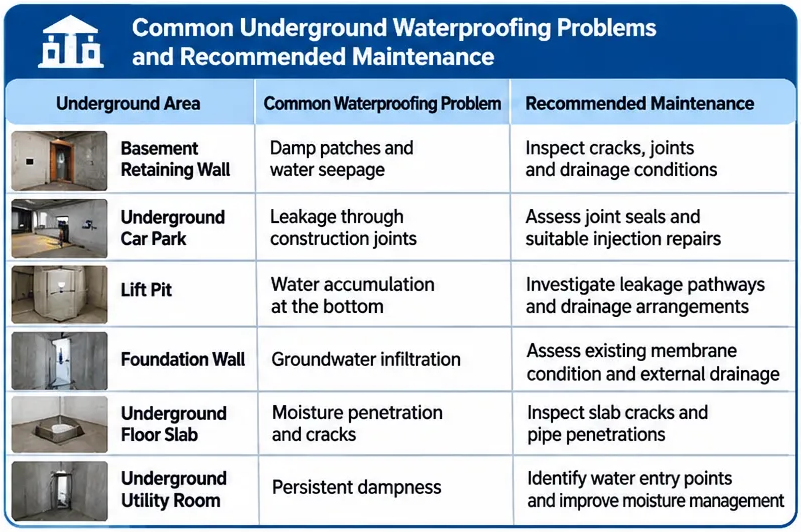
The recommended repair method should always be selected according to the actual leakage source, groundwater conditions, substrate condition and existing waterproofing system.
How to Choose the Right Underground Waterproofing Repair Method
Not every underground leakage problem can be resolved using the same waterproofing material.
For example, applying a waterproofing coating to an accessible concrete surface may be suitable for certain moisture-related conditions, but it may not stop active groundwater flowing through a construction joint.
Before selecting a repair system, consider the following factors:
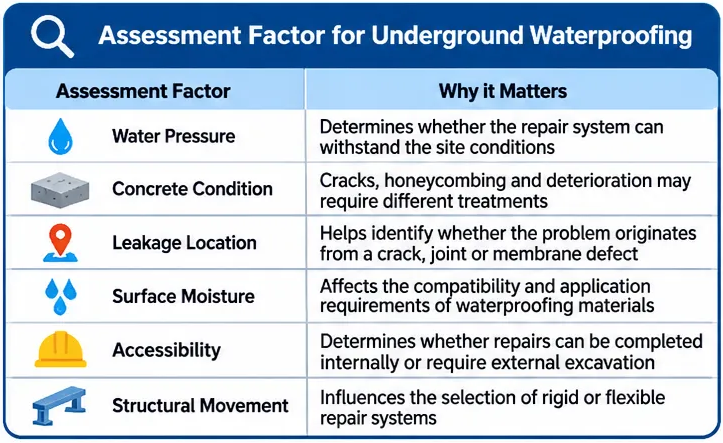
A proper site assessment helps reduce unsuitable material selection and repeated repair work.
How Often Should Underground Waterproofing Be Inspected?
The inspection frequency depends on the waterproofing system, groundwater conditions, building usage and previous leakage history.
As a practical maintenance guideline, property owners and facility managers can consider the following schedule:
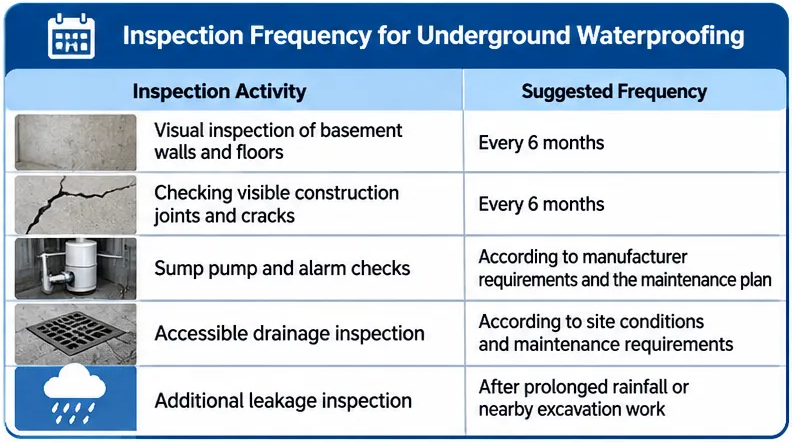
These are suggested maintenance intervals rather than universal regulatory requirements. Facilities with a history of water leakage or high groundwater exposure may require more frequent inspections.
For concealed waterproofing membranes, maintenance should focus on identifying signs of water ingress, protecting existing installations and monitoring the performance of associated drainage systems.
When Should You Engage a Professional Underground Waterproofing Specialist?
Some underground waterproofing problems can be managed through routine drainage maintenance. However, persistent water seepage or recurring leakage may indicate a more serious defect.
Professional assessment is recommended when:
Water continues entering despite drainage maintenance.
Basement walls repeatedly develop damp patches.
Active leakage occurs through concrete cracks or construction joints.
Water accumulates in lift pits or underground service areas.
Previous waterproofing repairs fail to resolve the problem.
Waterproofing membranes are suspected to be damaged.
A waterproofing specialist should investigate the source of water penetration before recommending injection, joint sealing, membrane repair or other waterproofing treatments.
For underground structures, identifying the actual leakage pathway is particularly important because the original waterproofing layer may be concealed and inaccessible.
Why Choose QingLong Waterproofing for Underground Waterproofing Solutions in Malaysia?
Choosing suitable waterproofing materials and repair systems is important for maintaining the durability of underground concrete structures.
QingLong Waterproofing is a waterproofing manufacturer and solutions provider with over 30 years of industry experience, serving residential, commercial and industrial waterproofing applications.
Our capabilities include:
1. Waterproofing Material Manufacturing
With in-house manufacturing capabilities, QingLong supplies waterproofing products designed for different building applications and project requirements.
2. Comprehensive Waterproofing Product Range
We offer waterproofing materials for various applications, including concrete protection, roof waterproofing, construction detailing and other building waterproofing requirements.
3. Technical Consultation
Our team helps customers understand waterproofing product selection, substrate requirements and application considerations based on project conditions.
4. Experience Across Different Building Applications
From residential buildings to commercial and industrial facilities, our waterproofing experience supports customers in evaluating suitable materials and waterproofing approaches.
5. Malaysia-Based Manufacturing and Supply
QingLong Building Supplies Sdn. Bhd. serves the Malaysian market with local manufacturing and product supply capabilities.
Whether you are a property owner, main contractor, waterproofing applicator or facility manager, QingLong can help you explore suitable waterproofing materials and technical solutions for your project.
Contact QingLong Waterproofing for Underground Waterproofing Solutions
Underground water leakage should never be treated as a surface problem alone. Whether the issue involves basement wall seepage, concrete cracks, construction joint leakage or groundwater infiltration, identifying the source is essential before selecting the appropriate waterproofing solution.
QingLong Waterproofing provides waterproofing materials, technical consultation and solutions for residential, commercial and industrial applications in Malaysia.
With over 30 years of industry experience and local manufacturing capabilities, we support customers in selecting suitable waterproofing materials for different building requirements.
Looking for suitable waterproofing materials or technical advice for your underground structure?
Contact QingLong Waterproofing at 019-776 6971 to discuss your project requirements.
Frequently Asked Questions (FAQs)
1. What is the best way to maintain underground waterproofing?
The best approach is to inspect accessible concrete surfaces, monitor cracks and construction joints, maintain drainage systems and investigate signs of water penetration early. The maintenance method should be based on the existing waterproofing design and site conditions.
2. What causes water leakage in underground car parks?
Common causes include defective construction joints, concrete cracks, damaged waterproofing membranes, poorly sealed pipe penetrations and groundwater pressure. Blocked drainage systems may also contribute to water accumulation.
3. Can basement waterproofing be repaired without excavation?
Yes. Certain basement leakage problems can be repaired internally using polyurethane injection, joint treatment or compatible internal waterproofing systems. However, extensive external membrane damage may require excavation to access and restore the original waterproofing layer.
4. What is the difference between polyurethane and epoxy injection?
Polyurethane injection is commonly used to address suitable active water leaks through concrete cracks and joints. Epoxy injection is generally used for appropriate structural crack repairs where bonding and restoration of concrete continuity are required. The selection depends on the crack condition and repair objective.
5. How long does underground waterproofing last?
The service life depends on the waterproofing material, installation quality, groundwater exposure, structural movement and protection against physical damage. Proper design, installation and maintenance can help improve the long-term performance of the system.
6. Can waterproofing coating stop active groundwater leakage?
Not necessarily. A conventional waterproofing coating may not withstand active pressurised water entering through cracks or construction joints. Water-stopping injection, drainage improvements or other corrective treatments may be necessary before applying a suitable waterproofing system.
7. How often should underground waterproofing be inspected?
A visual inspection every six months is a practical starting point for many facilities. Buildings with persistent groundwater exposure, previous leakage problems or critical underground spaces may require more frequent monitoring.


